
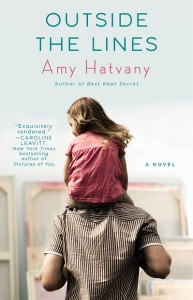
 Amy Hatvany’s latest novel, OUTSIDE THE LINES, is the story of a woman searching the homeless shelters of Seattle for her long-missing father who suffers from bi-polar disorder. Part mystery, part love story, it’s a fascinating exploration of the interior of a mental illness, and of what holds us back in life. Along with garnering many positive reviews, OUTSIDE THE LINES was selected by Target as the February 2012 Book Club Pick.
As wonderful of a writer as Amy is, it’s not her only talent, and I like how her website and Facebook page give a real sense of her personality. For instance, true to her love of cooking, her website offers some delicious-looking recipes, in addition to book information. I posed some writerly and not-so-writerly questions to Amy, which she answered with her characteristic humor and honesty. Here’s what she tells us:
When you’re faced with a tough stretch in your writing—writer’s block, indecision, a sudden desire to go out and interact with real people—how do you get through?
Ha! You mean besides compulsive eating? Seriously, I think the only way past that kind of struggle is to push my way through it. I attempt to focus on the next indicated step – what is the next thing my character would do or say? What’s the most logical next scene? I put myself into task-master mode – just write the next thought, Amy; the next sentence, the next paragraph. I remind myself that I can’t edit a blank page. I also have a few wonderful writer friends whom I can call and discuss my situational angst. We mull over character arcs, gossiping about them like they were our friends until we figure out their next steps. I’m not a big fan of walking away from a work in progress for very long – giving myself a break from it – simply because for me, it becomes all too easy to abandon it altogether.
Social media. Discuss.
When my first two novels came out ten years ago, there was no such thing as social media, and my, oh my, how the authorly world has changed. With the advent of Facebook and Twitter, I’ve had the amazing experience of being able to connect with other writers and readers in a way I never have before. It’s such a gift to be able to reach out and have so many gracious, lovely people respond. I’ve formed such wonderful friendships online and have had the privilege of strengthening those connections in real life.
The downside, of course, is the time-suck that these mediums can be for a writer. I’m not as good as I should be about setting boundaries – logging onto Facebook to see what everyone is up to can quickly spiral into a wasted morning or afternoon. I also think that in some ways, readers being able to connect daily with their favorite authors has affected how many people show up at book signings or other events. In some way, they feel that they already “know” you, so the impetus isn’t as strong to come see you in person. (I don’t know if this is really true; it’s simply a theory I came up with to address why attendance at their events has gone down for many authors, even some of the “big names” out there.)
Name a favorite object. (No body parts, please.) Tell us why you like it so much.
I have a blanket my mother sewed for me when I was fourteen years old that I just adore. There’s nothing fancy about it: it’s simply two pieces of thick, furry fleece sewn together. One side is dark purple and the other is off-white and I can’t remember a night at home that I haven’t slept with it for the last (gulp!) twenty-five years. It’s what I wrap around my children when they’re ill – they call it Mama’s Get Well Blanket. I’ll probably have to cut it in half so they each can have a piece of it when I die!
What’s the best, worst or most unusual advice you’ve gotten about writing, publishing or promoting your work?
When I first signed with her, my agent gave me a very sage piece of advice. She told me that I needed to be able to summarize my novel in one compelling sentence. If I couldn’t, then I didn’t have a strong enough idea to carry an entire book. At the time I thought she was a little nuts. How was I supposed reduce three hundred pages to three lines? But I soon realized that readers don’t want a lengthy synopsis when they ask you what your book is about – they want a sound byte. They want a brief description that will make them gasp a little and say, “I must read that story!” They’re looking for a tagline. It’s the line that will stay with the reader, the one that will – hopefully – lead them to your book instead of another. If I can pass on any piece of knowledge to an aspiring writer, it’s to know thy hook!
What’s one piece of advice you wish you could tell your pre-published self?
It would definitely be: Calm down! This writing journey you’ve embarked upon isn’t going to be a straight line. There will be spirals upward, then back down again. You’ll zigzag all over the dang place. But wherever you are, whatever you go through, you are exactly where you’re supposed to be. Embrace it. Learn from it. And most of all, write about it.
Leave a Reply